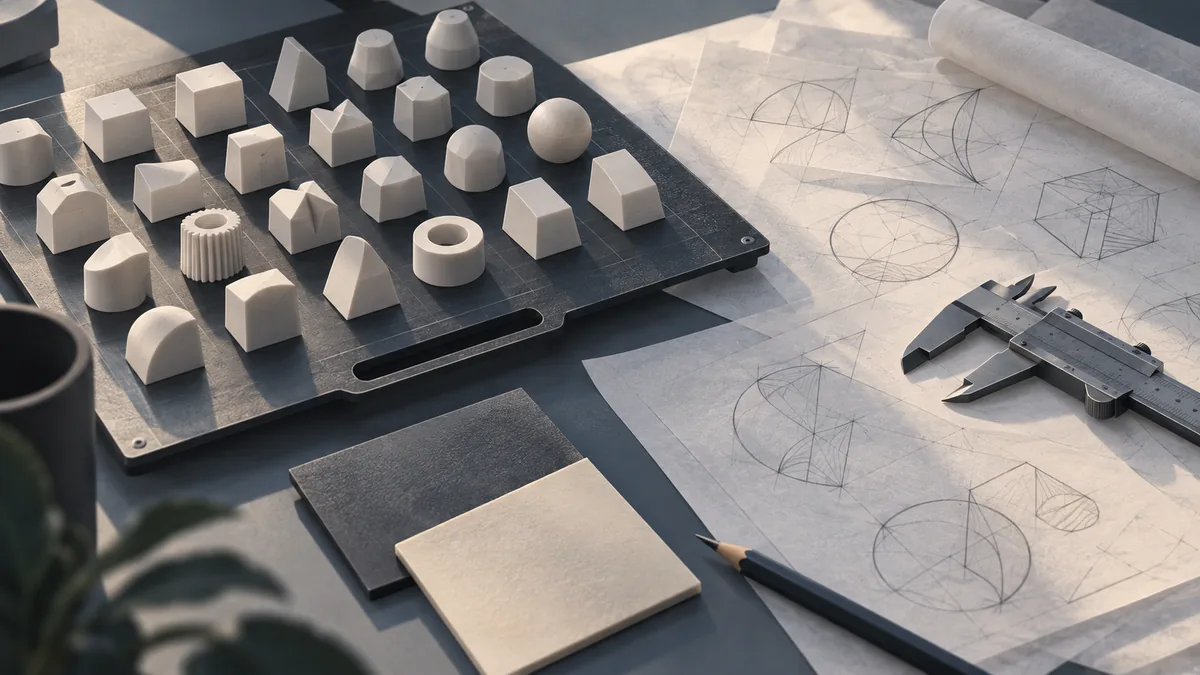
A flat visual identity can become a physical object, but the translation is rarely automatic. Second Flight Studios completed an order of approximately 300 custom 3D-printed pieces for Burlington Technical Center, developed from its school-related visual identity.
This is a view into the decisions we can verify: design iteration, test prints, plate planning, material choices, and the balance between appearance and production efficiency. We are not claiming a particular delivery time, budget, failure rate, or client reaction.
A logo has to work as an object
Artwork is normally designed to be seen flat and at a chosen size. Printing introduces thickness, edges, connection points, and a front and back. Narrow strokes may become fragile; tiny negative spaces may close up; a shape that reads clearly on a screen may need simplification when held. The initial design work therefore asks which features carry the identity and which can change without losing it.
For Burlington Technical Center's order, the starting point was its visual identity. The challenge was to make it recognizable as a dimensional piece while keeping the form repeatable across a large group of objects. That meant iteration rather than treating the first converted outline as final.
Test prints answer different questions
A digital preview can show overall form, but a physical test lets you assess scale, feel, edges, and visual clarity. A first sample may lead to thicker details or a different orientation. Another test might be about surface appearance or how neatly a part comes off the print bed. Each adjustment is easier to make before hundreds of pieces are in progress.
We used test prints as part of the project. We do not have an approved public record of the number of revisions or their exact causes, so it would be misleading to turn that process into a tidy step count. The lesson is simpler: sample approval is a production decision, not decorative paperwork. The broader path from logo to object explains what to check in that stage.
Planning for a batch of roughly 300
At this scale, layout on a print plate becomes part of the work. Packing more objects onto a plate can reduce handling, yet crowded arrangements may make removal, surface quality, or consistency harder to manage. Orientation affects visible lines, support needs, and the part of the object that meets the bed. The right plan aims for repeatable quality, not the most pieces visible in one screenshot.
Material decisions also have a production side. A color and finish must make sense for the identity, but the material must also print consistently in the chosen shape. We balanced output quality with production efficiency on this order. That does not imply a universal material recommendation; PLA and PETG have different tradeoffs for different uses.
As pieces accumulate, the job shifts from making an acceptable sample to keeping the accepted standard. That means checking the features that matter most, keeping batches organized, and allowing time for finishing or packing. These are ordinary small-production concerns, and they are easy to undercount when a quote focuses only on printer time.
What we learned about custom work
There is a useful distinction between a sample that is attractive and a design that can be repeated. For one piece, a maker can spend extra time cleaning an awkward edge or adjusting a small detail. Across roughly 300 pieces, that manual rescue becomes part of every unit. The design has to carry enough of the original identity while remaining practical to produce and inspect. Plate planning and material choice are therefore design feedback, not just workshop logistics. A batch forces you to ask whether the approved example describes what the recipient will actually receive.
This is also why we would not infer a cost or turnaround from the quantity alone. The same number of objects in a different shape, size, or finish could be a very different assignment. What transfers from this work is the method: make the visual idea physical, test the important features, then plan repetition around the accepted sample.
This project is a good example of why a custom object can be meaningful to an organization: the item comes from its own visual language. It is also a reminder that a meaningful object needs a realistic manufacturing plan. A detailed design that takes too much intervention per piece may be suitable as a single gift and a poor choice for a few hundred recipients.
Smaller runs offer room to match a particular group or purpose. Our article on small-batch production versus generic items considers when that extra specificity is worth it. If you have artwork and an approximate quantity for a school, nonprofit, or community group, share the intended use and the important date. We can discuss what should be tested before anyone commits to a full run.