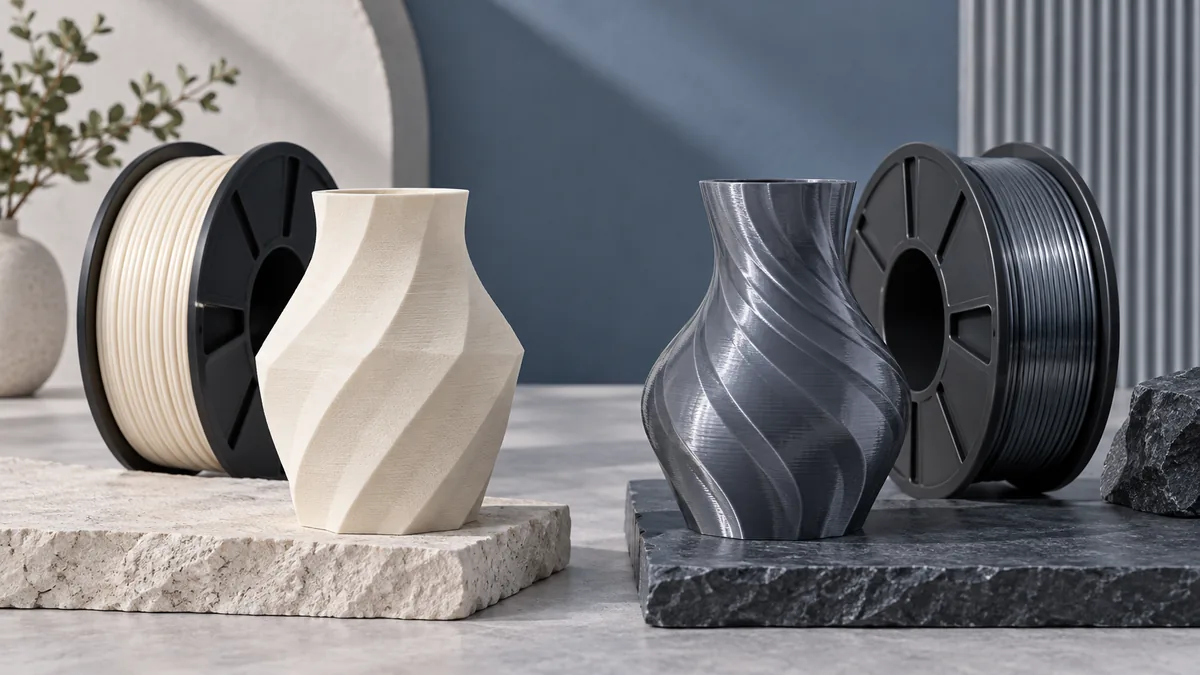
PLA and PETG are common names in desktop 3D printing, but a material name is not a finished specification. Geometry, print settings, environment, and the way an object is handled all affect the result. If you are commissioning a custom piece, you do not need to become a materials engineer. You do need to describe where the object will live and what it must tolerate.
Here is the practical difference we would discuss at the beginning of a project. For a demanding or regulated use, a general blog comparison is no substitute for application-specific testing and professional requirements.
PLA: often a straightforward starting point
PLA is frequently used for visual prototypes and indoor display pieces. It can support clear details and a range of colors, and it is often comparatively straightforward to print. For a desk object or event piece that will be used in ordinary indoor conditions, it may be a reasonable candidate.
Its limitations become important when heat, prolonged sun, load, or repeated mechanical stress enters the picture. A part left in a hot car is a different assignment from one resting on a shelf. Do not choose PLA merely because it printed nicely in a sample if the real use is more demanding.
PETG: useful for a different set of constraints
PETG may be worth considering for a piece that needs a different balance of toughness and use conditions. That is not a blanket guarantee of outdoor durability or safety. Some designs can show different surface behavior, stringing, or finishing needs compared with PLA. The best-looking sample in one material may require changes in another.
When someone asks for the “stronger” option, we ask what failure would actually look like. Is the part meant to flex? Hold a small load? Be handled by many people? Stay dimensionally stable in warmth? The answers can change the geometry as well as the material. A thicker feature or different orientation may matter more than swapping filament.
The visual decision belongs in the quote
Color, sheen, texture, and visible layers affect whether a custom object looks right for its purpose. Requesting a material without seeing a representative finish can set up a mismatch. A sample at the intended scale is useful, especially for branded pieces where fine detail matters. The logo-to-object process explains why the physical proof matters.
Material also affects production efficiency. A larger batch needs consistency across plates and sensible handling. We included material decisions in our approximately 300-piece educational project, though we are not publishing an unverified specification for that order.
Questions to answer before choosing
Color is another reason not to choose from a material name alone. Two spools described with the same color word can look different under ordinary light, and a final surface can appear different from a digital rendering. If a precise brand match matters, say so before quoting and agree on a physical approval method. A producer may need to explain limits rather than guarantee an exact match.
For a batch, ask whether the tested sample will use the same material, orientation, and settings as production. A beautiful sample printed under different conditions may not answer the questions that matter for the final objects. Agree on what is being approved: appearance, fit, handling, or a combination.
A simple indoor display piece and a frequently handled clip illustrate the difference. For the display, color and crisp visual detail may dominate the choice. For the clip, repeated movement and fit become more important, so the geometry, material, and print orientation need to be evaluated together. Printing one sample and bending it once is not proof of long-term performance. If a part must hold something valuable or prevent harm, the project needs an appropriately qualified design and test plan rather than a casual material swap.
Ask for a sample made in the intended material and orientation. A sample printed differently from the production batch may answer the wrong question. Record what the sample is meant to demonstrate—appearance, fit, handling, or another criterion—so approval has a clear meaning.
- Will the object be indoors, outdoors, in a vehicle, or near a heat source?
- Will it be decorative, frequently handled, or under load?
- Is a precise appearance more important than mechanical behavior?
- Can a physical test be reviewed before a full batch?
- Are there safety, food-contact, electrical, or other requirements that need qualified review?
Those answers belong in your custom-print quote request. They also help determine whether 3D printing is the right process at all. If you are unsure which material fits, describe the actual use to us; we can propose what to prototype and where more testing would be necessary.