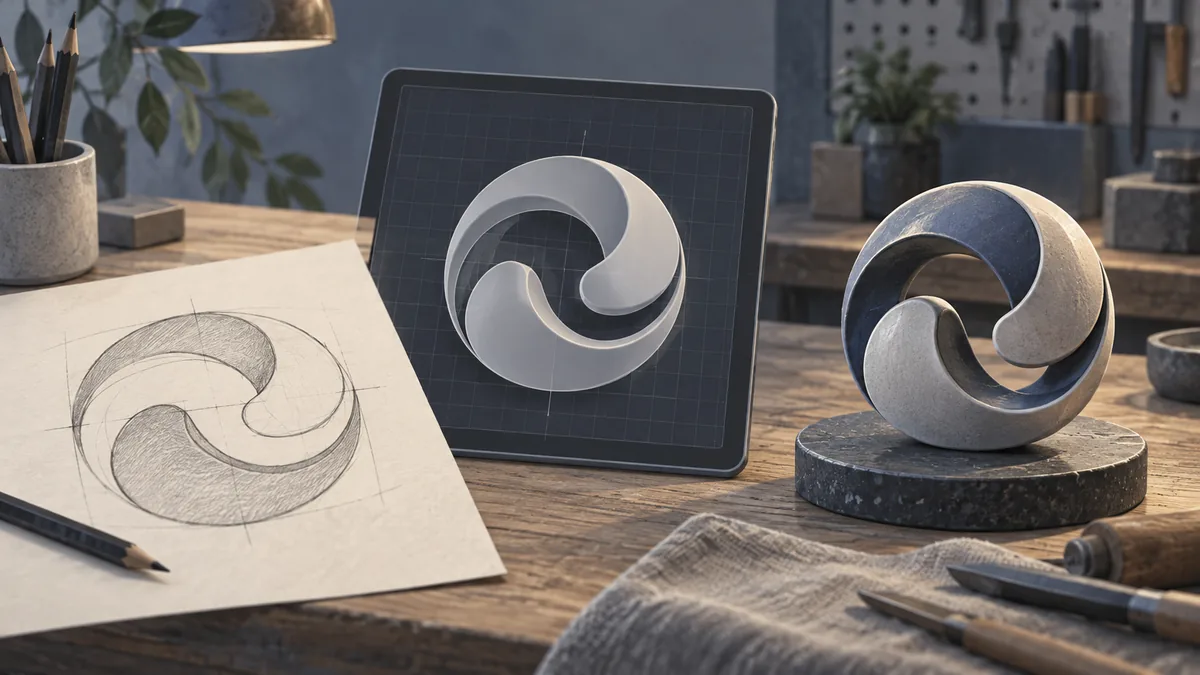
A logo is a set of visual decisions made for paper or a screen. A physical object needs another set: thickness, edges, balance, material, and a way to survive handling. The interesting part of custom branded 3D printing is deciding which qualities of the original artwork must carry through and which have to change.
We have done this translation for an approximately 300-piece educational order. The following process describes the questions that guide a project like that; it is not a claim that every logo is ready to print as supplied.
Identify what makes the mark recognizable
Start with the simplest version of the artwork you are allowed to use. Vector files can help, but an image can still begin a conversation. Look at its important silhouette, internal gaps, tiny lettering, and colors. A thin stroke that is attractive on a page may become a weak bridge in plastic. A tiny opening may disappear at the intended size. If the identity depends on those details, the object may need to be larger or designed differently.
Permission also matters. A studio should not assume that a person requesting an object owns the mark or has approval to reproduce it. For an organization, identify who can sign off on the artwork and the physical adaptation before production begins.
Decide what the object will do
A flat relief meant to sit on a desk differs from a keychain, badge, wall piece, or part attached to another item. Where will a hole or base go? Which face should look best? Will people carry it, display it, or use it repeatedly? The answer affects thickness and orientation before it affects color.
A dimensional mockup makes these choices easier to discuss. It should show scale and the parts that may need simplification. It can also reveal when 3D printing is the wrong method. If the desired result is a perfectly flat full-color graphic on a very thin item, another process may reproduce that visual idea more faithfully. Our comparison with traditional promotional products helps make that call.
Prototype in the intended size
Holding one piece often changes the conversation. Lettering that looked substantial on a monitor may feel too small. An edge may need softening. A mounting detail may be awkward. Test prints let us assess the designed object as an object. They also help reveal surface characteristics such as layer lines and the marks left by supports.
Approve a physical sample against the purpose of the piece, not against an impossible expectation of a molded or machined surface. If the sample is close but not right, decide which changes matter enough to repeat the test. For a batch, the cost of discovering an issue late is much greater than the cost of a useful early revision. Our educational-order story describes the role of iteration and plate planning at larger quantity.
Plan the run, not just the model
Imagine a circular mark with narrow lettering around its edge. At a generous size, those letters may print clearly; reduced to a small giveaway, they may be unreadable. One response is to enlarge the whole item. Another is to retain the central silhouette and move the words to a card or package. A third is to use a different manufacturing process. The “faithful” result is the one that carries the intended identity for the person holding it, not necessarily the one that copies every line of the original file.
This decision belongs with the organization approving the artwork. A physical adaptation can be recognizable and still require consent from the person responsible for the brand. Showing a sample next to the flat mark makes the tradeoff visible before the run begins.
Once the shape is approved, a producer must choose orientation, plate layout, material, and a standard for acceptable finish. A little feature added to every object may add significant handling across a batch. Multiple colors, assembly, or individual personalization can be worthwhile, but they are production requirements and should be scoped explicitly.
If the work is for an event, the date should include time for approvals, production, finishing, and delivery. If the budget is tight, ask what can be simplified while preserving the mark's character. The quote-request guide lists the inputs that make this discussion productive.
The result should still feel like the organization's idea, now made tangible. If you have a mark and a possible use for it, send the artwork and intended quantity to Second Flight Studios. We can discuss what a first test would need to prove.