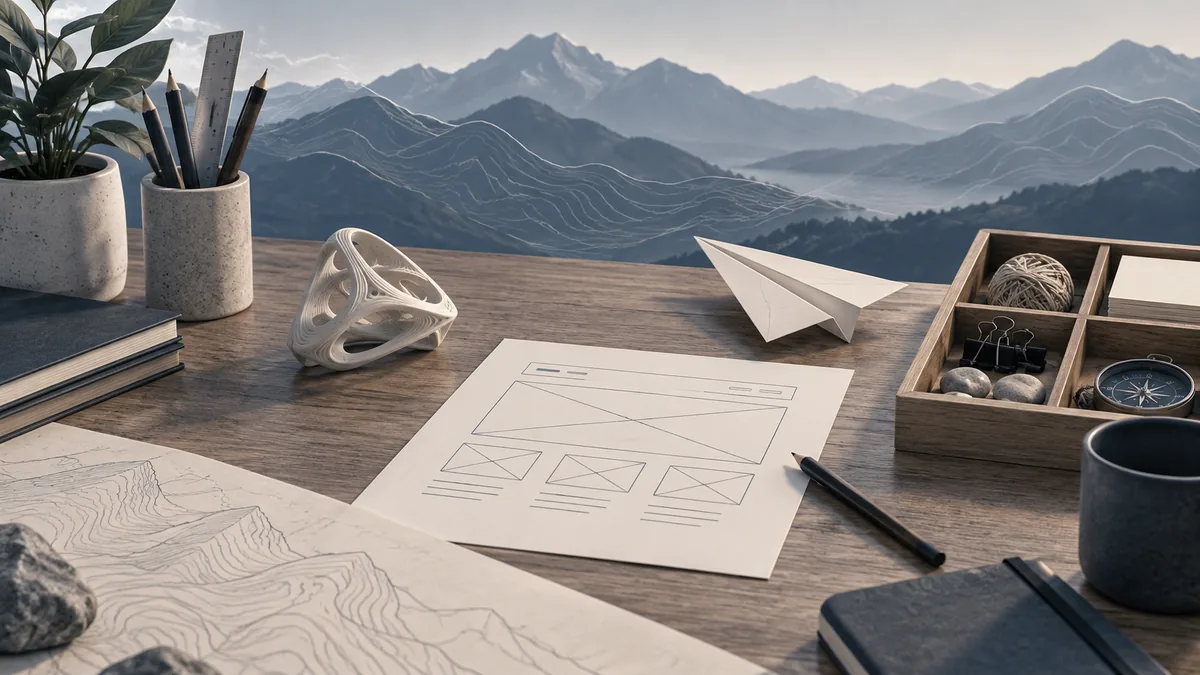
It is fair to notice the objects first. A physical piece is easy to photograph, hold, and pass around. But Second Flight Studios was built around a broader question: how do you move an idea from “maybe” to something useful in the world?
We are based in St. Albans, Vermont. Our work sits between a creative studio, a small production shop, and a practical technology company. That mix is not an attempt to make every project more complicated. Sometimes design and production are the whole assignment. Sometimes the useful work is a better website or a clearer way for a business to handle inquiries.
Design makes the question clearer
Before deciding what to make, we want to understand who it serves and what should happen when they use it. A visual identity may become a dimensional object; a website may need to explain a service without forcing visitors to decode jargon; a workflow may need to make one handoff visible.
Design in this sense includes editing. Removing a fragile detail from a physical object or a redundant step from a form can improve the result. It is often more valuable than adding another feature.
Production makes tradeoffs visible
We completed an approximately 300-piece order for Burlington Technical Center based on its visual identity. It involved iteration, test prints, material decisions, plate planning, and balancing quality with production efficiency. Those are concrete lessons in turning an idea into a repeatable object. The Burlington Technical Center case study shares the work without inventing a project outcome.
For some ideas, 3D printing is a good route because a small batch can carry a specific shape. For others, a catalog product or another manufacturing process is more sensible. Our guide to custom 3D printing in Vermont explains the first questions we ask, including use, size, materials, and time.
Digital work has physical consequences
A website is where someone decides whether to make contact. If its form fails or the inquiry has no owner, a visitor's effort is wasted. That is why practical technology work belongs alongside creative and production work for us. Clear pages, dependable capture, and honest status are all part of how an idea reaches a real person.
Our public contact path saves inquiries for manual review. In parallel, we are developing an internal AI-assisted lead inbox. We want it to preserve the original message, offer a useful draft when available, and keep human review and explicit approval separate from delivery. It is still evolving. What we are learning from building it for ourselves explains both the aim and the limits.
We do not want software to replace the relationship
AI can help prepare or organize work. It can also sound confident when it is wrong. A customer deserves a reply grounded in the actual request and in what the business can do. Our human-approval article describes why the owner remains in control of customer-facing messages.
The same principle applies in a workshop: a machine can repeat a form, but someone still decides whether the form is right. We are interested in tools that give people room to notice, decide, and follow through.
The thread connecting the work
There is a practical advantage in seeing these disciplines together. A branded object may need a page that explains how to request it. A good page may still fail if its form does not preserve the inquiry. A workflow might route the inquiry correctly but generate a reply that needs human judgment. Each part affects whether the original idea reaches a useful outcome. We do not have to deliver every part of every project, but understanding the connections helps us ask better questions and avoid solving a narrow symptom while leaving the next handoff broken.
For a small studio, that also means being candid about scope. We can discuss a physical prototype, a digital experience, or a repetitive process, then decide which work is appropriate. We should not describe an evolving internal system as a finished product or pretend one technology is the answer to every customer.
Our services may look varied from the outside. The common work is translating an intention into a practical result, then checking what happens when a person uses it. A printed piece has to feel right in the hand. A page has to make sense to a visitor. An intake process has to preserve the question and support a real answer.
If you have an idea that crosses those boundaries, tell us what you are trying to make or improve. We can begin with the problem and decide together which kind of work it actually calls for.