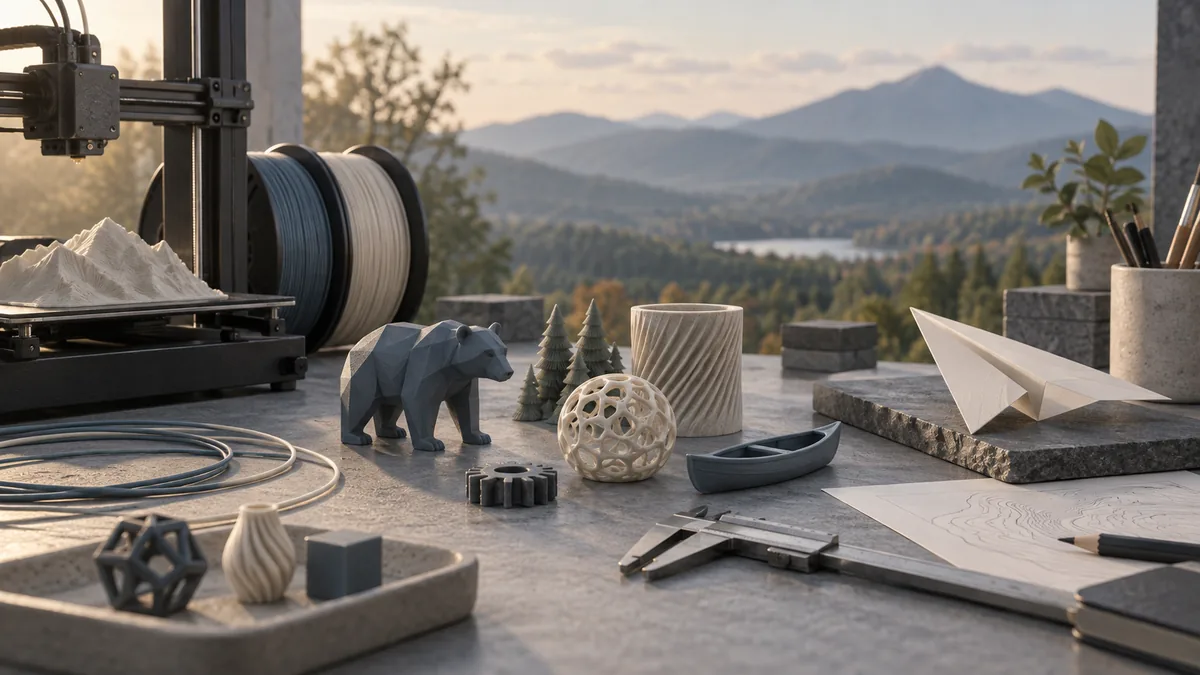
Custom 3D printing works best when the object has a reason to be custom. Maybe you need a short run for a Vermont event, a prototype you can hold before committing to tooling, or a branded piece that a catalog cannot quite supply. The printer is one part of the job. Deciding what to make, how it will be used, and whether the result can be produced reliably matters just as much.
At Second Flight Studios in St. Albans, we combine design and small-batch production. This guide explains the questions we would ask before quoting a project. It is a planning guide, not a promise that every idea can be printed at a particular price or by a particular date.
Start with the use, not the file
An image of a logo is useful, but it does not tell us whether the finished item needs to hang, stand, clip, bend, travel, or survive a hot car. A display piece and a functional bracket lead to different shapes and material choices. If the object is a giveaway, tell us who will handle it and what you want them to remember. If it is a prototype, tell us which features must be accurate and which can stay rough.
Approximate dimensions are enough for an opening conversation. A photograph of a similar object, a sketch with one known measurement, or an example you dislike can be more helpful than a vague request for something “small.” We can help translate an idea into a printable design, but that design time belongs in the project plan.
What affects the cost?
There is no honest universal price per piece. A quote can include modeling or file repair, sample prints, material, machine time, finishing, packing, and the coordination needed to keep a batch consistent. A simple object supplied as a sound production file is a different job from turning a flat mark into a dimensional piece. A run of 20 and a run of 300 may spread setup work differently, but the larger run also needs more careful scheduling and quality checks.
We describe those cost drivers in more detail in how a custom printing project is priced. If you are gathering estimates, a useful quote request helps different producers respond to the same actual need.
How long should you allow?
Think in stages rather than asking only for a print duration. The initial conversation establishes use, size, quantity, files, and a desired delivery window. Design or file preparation comes next. A test print may reveal a thin feature, unclear lettering, or a support mark that looks fine on screen but wrong in hand. After a sample is approved, the remaining pieces need production time and checks. Packing or shipping adds another step.
The length of each stage depends on the design, queue, quantity, finish, and how quickly decisions can be made. We will not give a fictional “standard turnaround” for a custom job. If your event date is fixed, share it at the start. That can determine whether a simplified design or a smaller first batch makes sense.
For a glimpse of why the production stage deserves its own plan, read our Burlington Technical Center case study. The approximately 300-piece order involved iteration, test prints, material decisions, and plate planning, not simply pressing print once.
Materials and finish are decisions, not upgrades
PLA can be a good fit for many indoor display objects because it is approachable to print and offers a range of visual options. PETG may suit a piece that needs a different balance of toughness and use conditions, but it can change surface finish and production handling. Neither label alone guarantees that an object is right for heat, load, weather, or a regulated use. Geometry and testing still matter. Our PLA and PETG comparison explains the questions worth asking.
Color, surface texture, visible layer lines, and hardware attachment should also be discussed before pricing. A photograph may hide features that become obvious in the hand. We would rather agree on an acceptable sample than discover a mismatch after a batch is complete.
When local collaboration helps
Working with a studio in Vermont can make it easier to discuss a physical sample or a community event's practical constraints. Location itself does not make a project cheaper or faster. The benefit is a direct conversation about tradeoffs: perhaps a smaller object keeps the visual idea intact, or a two-part design is easier to finish than a single elaborate print.
If you are still comparing a custom piece with ordinary merchandise, our small-order comparison may help. For a specific idea, tell us the quantity, intended use, and date you have in mind. We can start by saying whether it looks practical to manufacture and what would need testing.